Value-Added Services | Case Study
Bank Amplifies VAS Portfolio with LOTTO

Value-Added Services | Case Study
Page contents

South African bank Chief Information Officers (CIOs) will play a critical role in the radical transformation being experienced in the payment ecosystem. Real-time payment volumes are not simply projected to grow; they are guaranteed to explode. This seismic shift will be compounded by changes across rails, powered by emerging technologies and turbocharged by the Artificial Intelligence (AI) revolution.
These changes collectively provide a once-in-a-generation opportunity to stand out from the competition. But, as we near 2030, this opportunity is slipping away.
For CIOs, infrastructure modernisation is not a choice; it is a business imperative. The evolving market will demand new thinking, maximum agility, and readiness to scale. Failure to act is no longer an option.
[insert figure 1]
The question for payments leaders is: How do you prepare your business for success?
By strategically balancing investments across four key areas, you will position your business to confidently lead the industry into 2030 and beyond.
Real-time payments are no longer optional. They reduce cash reliance, expand deposits, and unlock new opportunities in credit, insurance, and data monetisation. You need to embrace real-time to cement your business as the backbone of economic growth.
The future leaders in payments ecosystems will not merely process transactions; they will orchestrate commerce, harness data at scale, and shape new business models. Treating payments as an opportunity for differentiation, not simply a cost centre, will position you to compete with new players and adapt to regulatory changes.
Transaction volumes are set to surge. As ISO 20022 becomes universal, the distinctions between low-value and high-value and domestic and cross-border payments will disappear. Maintaining siloed platforms will cripple your agility. Consolidation is no longer about efficiency; it’s about staying relevant in a converging, high-speed payments landscape.
The future winners will separate themselves through decisive technology leadership. Not every innovation demands equal urgency, but falling behind on even one key enabler will weaken competitiveness.
Most urgently, AI is no longer experimental. If you treat AI as peripheral, you will be overtaken by those who embed it at the core of their products, operations, and risk mitigation.
Fraud is evolving faster than legacy controls can adapt. Without strong, adaptive defences, you will lose both money and credibility. At the same time, payment margins are under pressure. Operational efficiency is no longer about cost control; it is the foundation for delivering secure, scalable, high-quality services.
The leaders in next-generation payments software, Electrum and Cyan, the authority in digital transformation, have strategically partnered to bring our expertise and opinion to South African banks. Through this Report, we will help you to focus your modernisation efforts, ultimately enabling faster and smarter payments innovation.
We have looked beyond local examples and explored global case studies to identify the most impactful trends in payments and the key technological enablers that support them. We present a thorough analysis of these critical topics, culminating in a definitive reason to act, with the key implementation principles and steps.
As we enter this pivotal time in the evolution of payments, this Report makes two predictions for the ecosystem as a whole: (1) regarding volume growth and (2) regarding the future state of rails.
When it comes to the volume of real-time payments that South African banks should prepare for ahead of 2030, we have calculated three possible scenarios. These calculations forecast real-time payment volume growth of between 2x and 10x by 2030.
We believe that the likelihood of each scenario playing out, and its impact on banks, will be as follows:
This Report is your strategic guide to that future.
South Africa’s payments landscape has entered a defining decade due to technological advancements. At the same time, the South African Reserve Bank’s (SARB) Payments Ecosystem Modernisation (PEM) programme is driving the most ambitious national uplift to the payments industry that the country has ever attempted.
The leaders in next-generation payments software, Electrum and Cyan, the authority in digital transformation, have strategically partnered to bring our expertise and opinion to South African banks. Through this Report, we will help you to focus your modernisation efforts, ultimately enabling faster and smarter payments innovation.
We have looked beyond local examples and explored global case studies to identify the most impactful trends in payments and the key technological enablers that support them. We present a thorough analysis of these critical topics, culminating in a definitive reason to act, with the key implementation principles and steps.
As we enter this pivotal time in the evolution of payments, this Report makes two predictions for the ecosystem as a whole: (1) regarding volume growth and (2) regarding the future state of rails.
When it comes to the volume of real-time payments that South African banks should prepare for ahead of 2030, we have calculated three possible scenarios. These calculations forecast real-time payment volume growth of between 2x and 10x by 2030.
We believe that the likelihood of each scenario playing out, and its impact on banks, will be as follows:
Until recently, Electrum’s Bank customer offered only the essential VAS but the Bank understood from its customers that they expected the same digital offerings as offered by other banks. As a Top 5 Bank, expanding to include entertainment services was a logical and competitive next step. This was achieved quickly by adding LOTTO as a service: giving clients the ability to play LOTTO, PowerBall, and Daily LOTTO via the Bank’s app.
As customer demand indicated that the service would have a high uptake from the Bank’s clients, the solution needed to be highly scalable and dependable when it came to transaction volumes and error handling. Fast adoption by the Bank’s customer base was proven as the new offering saw high usage in the first few days after launch. In line with the need for excellent usability, playing LOTTO needs to be as simple as possible for their customers, with access across multiple bank channels.
Of course, a well-run bank will always look to cut out-loss making and unnecessary operational overheads. The solution needed to ensure as much straight-through processing as possible, of both the wager and winnings payouts, in order to reduce the need for daily manual operational processes.
Electrum implemented an iThuba LOTTO integration combined with a reconciliation and settlement solution which allows:
To meet the Bank’s affordability objective, the solution fully automates not only the wager placement transactions, but also the payment of winnings into clients’ bank accounts. This important feature ensures that winners will get paid out automatically, with the winnings transferred straight into their bank account (for amounts up to R250 000). There is no need for players to visit stores or physical branches to claim their winnings - saving them time and making the funds available immediately. The automated back office functionality system also processes reconciliation and settlement wagers daily, and simplifies business reporting.
In addition to processing the payouts, the LOTTO solution enables the Bank to discern the various tiers of winners so that payouts can be processed in accordance with iThuba Service Level Agreements.
The Bank already uses Electrum's Value-Added Services solution to process Prepaid Airtime, Prepaid Electricity, and Bill Payment transactions and so trusted them to provide another high-volume service in the form of LOTTO. Electrum provided the iThuba integration to the Bank, complete with the necessary error handling, monitoring and alerting, and reporting. This meant the Bank could launch the LOTTO service with confidence, knowing that the Electrum solution is robust and scalable enough to handle the high transaction volumes expected from the service from the first day of operation.
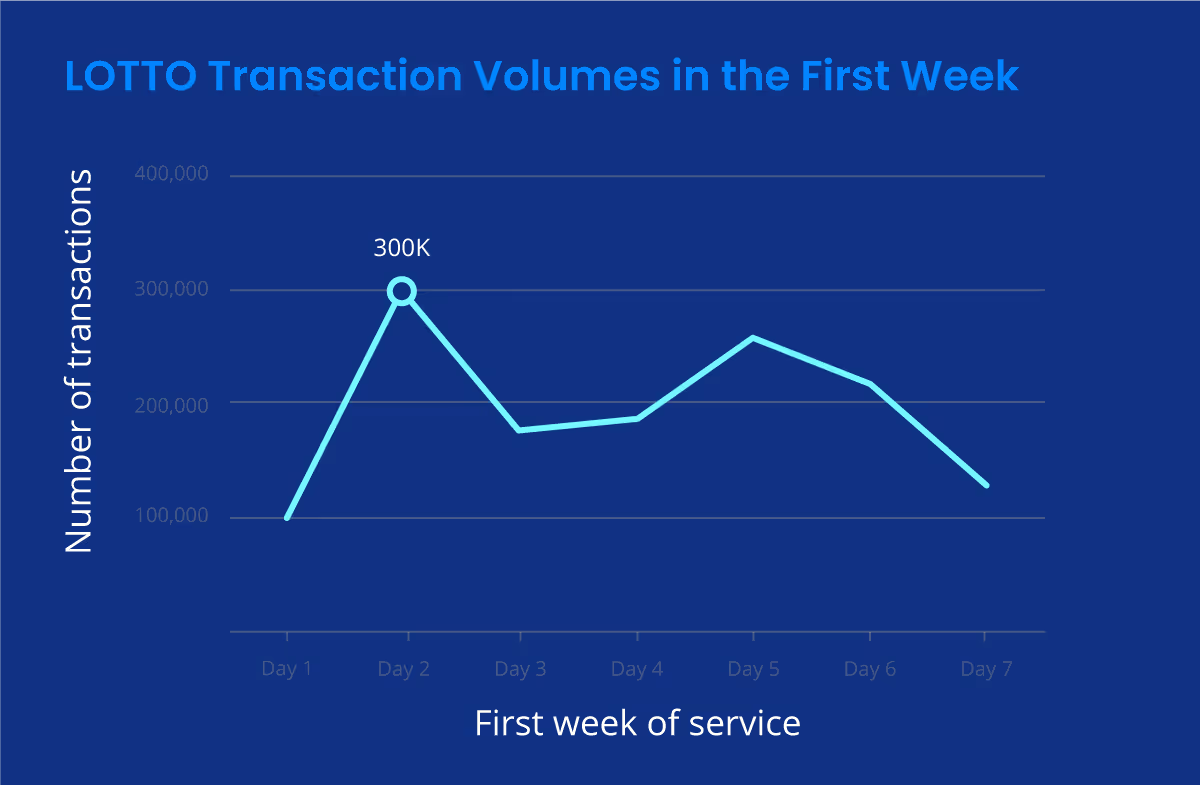
“The service was very rapidly adopted by consumers upon launch and has proven itself to be reliable and scalable so as to support the Bank’s overall goals of meeting customer expectations.”
Werner Pyke, Electrum Head of Product
Looking to grow your VAS portfolio? Book a demo today to find out how Electrum can help your business meet customer expectations.


